

In a time of evolving workforce dynamics, Canadian employers are seeking talent beyond borders to tackle labor shortages. With factors like an aging population and low birth rates leading to a shrinking workforce, international recruitment has become crucial to fill vital roles and fuel innovation in Canada’s economy. Industries spanning healthcare, technology, and skilled trades require specialized expertise that often exceeds the capabilities of the current domestic workforce, prompting businesses to explore talent acquisition strategies on a global scale.
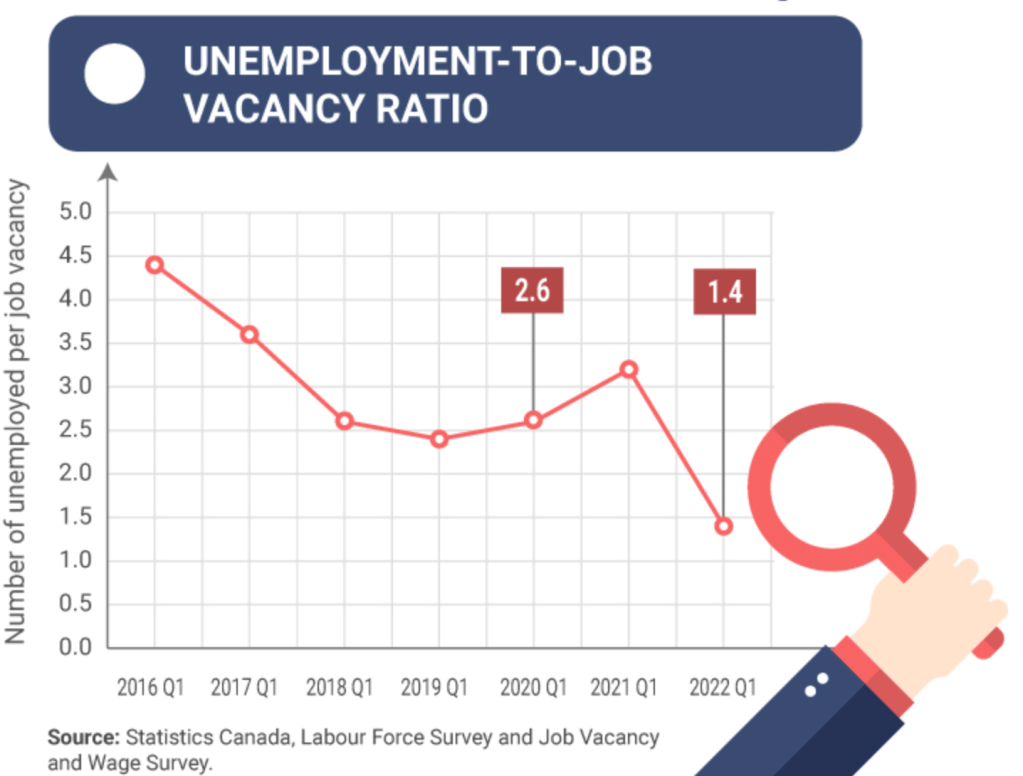
Reports from Statistics Canada underscore the severity of the situation, with the unemployment-to-job vacancy ratio at a historical low, indicative of a tight labor market where employers struggle to fill vacant positions. Across various sectors, from construction to manufacturing and accommodation and food services, recruiting skilled employees emerges as a prominent obstacle for businesses. Moreover, retaining skilled talent poses a significant challenge for over a quarter of enterprises, highlighting the urgency of addressing labor shortages to sustain business growth and competitiveness.
The impact of labor challenges extends beyond operational constraints, as evidenced by the findings of a report by the Canadian Federation of Independent Business (CFIB). Small businesses in Canada alone missed out on over $38 billion in revenue opportunities in 2022 due to the need to turn down or postpone contracts or sales owing to labor shortages. This emphasizes the need for businesses to adjust their talent strategies to benefit from a global talent pool, ensuring resilience amidst changing workforce dynamics.
Global Talent, Local Impact: The Advantages of Hiring Foreign Workers
By embracing international talent, companies access a treasure trove of benefits. Here are a few notable benefits that highlight the importance of considering global talent acquisition:
- Innovative Ideas: Integrating foreign talent infuses fresh perspectives, igniting creativity and adaptability within the team. Diverse thinking sparks innovation, propelling the company forward and ensuring its relevance in a dynamic market.
- Expanded Expertise: International hires bring a diverse skill set, bridging gaps and fortifying organizational capabilities. With a broader skill set, teams confidently tackle challenges, leading to stronger solutions and overall improved performance.
- Filling Critical Roles: By tapping into global talent pools, companies can swiftly fill critical positions, avoiding disruptions and maintaining momentum in their strategic initiatives.
- Cultural Fluency: Diversity fosters cultural understanding and global connectivity, fueling collaboration in diverse environments. In our interconnected world, navigating such environments is crucial for success on a global scale.
- Proven Adaptability: Immigrants demonstrate resilience, assisting companies in navigating challenges with ease. Their resilience in new environments makes them invaluable assets during uncertain times, aiding the company in overcoming challenges and emerging stronger.
- Strong Work Ethic: Immigrants’ dedication, motivation and strong work ethics contribute to a positive work culture, driving organizational success.
- Enhanced Corporate Image: Diversity hiring practices bolster reputation and resonate with inclusive values, enhancing corporate image. Companies that prioritize diversity and inclusion are seen as progressive and socially responsible.
- Boosted Productivity: Teams that embrace diversity are more innovative and adaptable, leading to faster decision-making, better problem-solving, and ultimately, higher levels of productivity and performance.
Exploring Pathways: A Guide to Hiring Foreign Workers in Canada
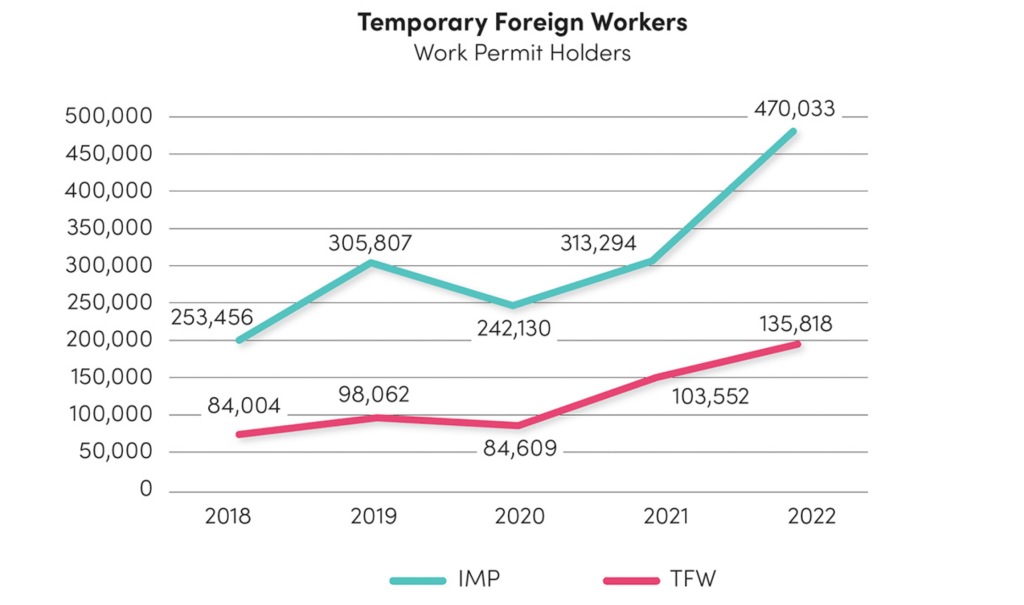
The uptick in work permit issuance for foreign workers underscores Canadian employers’ growing dependence on international talent. Illustrated in a graph from the 2023 Annual Report to Parliament on Immigration, this trend highlights the reliance on foreign expertise. The report identifies the International Mobility Program (IMP) and the Temporary Foreign Workers Program (TFWP) as the primary pathways for securing work permits. Read below for more insights on these programs.
Temporary Foreign Workers Program / LMIA Work Permits:
The Labour Market Impact Assessment (LMIA) is a critical document that Canadian employers must obtain when hiring international workers through the Temporary Foreign Worker Program (TFWP). Here’s a few details about the LMIA process:
- Permit for Hiring International Workers: The LMIA serves as a permit for hiring international workers, allowing Canadian employers to fill temporary job vacancies with foreign workers.
- LMIA Requirement: Employers need to apply for an LMIA if the intended foreign worker does not fall under an exemption category. This assessment evaluates the potential impact of hiring a foreign worker on the Canadian labour market.
- Validity and Availability: Once granted, the LMIA enables the employer to hire the foreign worker for up to 18 months. This permit is available for both high-wage and low-wage workers, providing flexibility in hiring across various sectors.
- LMIA Streams: The LMIA process consists of different streams tailored to specific job categories:
- Low-Wage Stream: Designed for low-skilled occupations.
- High-Wage Stream: Targeting highly-skilled workers.
- Dual Intent Stream: Designed to offer work permit in either of the categories and also assist in permanent residency.
- Agricultural Stream: For hiring farm workers.
- Seasonal Agricultural Stream: Catering to seasonal farm workers.
- Global Talent Stream: Geared towards recruiting tech or specialized roles, facilitating expedited processing for eligible positions.
- Employer Requirement: Employers seeking an LMIA must fulfill several requirements:
- Advertise the job in Canada. The advertisement must meet specific requirements as listed by ESDC.
- Actively recruit Canadian citizens or permanent residents.
- Ensure compliance with employment standards.
- Provide evidence of the need for hiring a foreign worker.
- Demonstrate financial capability.
- Adhere to LMIA conditions upon approval.
- Business Legitimacy Requirement: Employers’ job offers are rigorously evaluated for authenticity and legitimacy. ESDC considers the following supporting documents to ensure your business:
- Operates legitimately in Canada.
- Provides job opportunities aligned with your genuine needs.
- Can fulfill all job offer terms.
- Demonstrates compliance with regulations.
- A job offer must meet these criteria to be considered genuine and legitimate. Non-compliance with any factor may lead to a negative LMIA decision.
International Mobility Program / LMIA-Exempt Work Permits:
The International Mobility Program (IMP) provides Canadian employers with the opportunity to recruit temporary foreign workers without undergoing a Labour Market Impact Assessment (LMIA). While an LMIA is typically mandatory for hiring temporary foreign workers in Canada, various exemptions exist to alleviate this requirement. Here’s the breakdown of International Mobility Program (IMP) and LMIA-Exempt Work Permits:
- Simplified Process: If the job falls under exemptions, employers can benefit from a streamlined process for hiring foreign workers. This simplified process reduces administrative burdens and facilitates quicker hiring decisions.
- Duration of Stay: Workers hired under LMIA-exempt categories are typically allowed to stay and work in Canada for up to 24 months. This provides flexibility for employers and workers alike, allowing for longer-term employment arrangements.
- LMIA Exemption Streams: Exemptions from the LMIA requirement were made to recognize situations where hiring foreign workers directly contributes to Canada’s economic, cultural, or social objectives. These exemptions are granted under various streams including:
- Public policies
- Intra-Company transferees
- International trade agreements or arrangements
- Canadian interests
- Francophone Skilled Worker
- And other specific circumstances outlined in immigration regulations.
- Employer Requirements: Unlike TFWP, employers are not required to show the comprehensive recruitment efforts. However, certain requirements still apply:
- Employers must register and create an account on the Employer portal for LMIA exempt job offers.
- Submit the job offer through the employer portal, ensuring accuracy and completeness of all required information.
- Adhere to guidelines and regulations outlined by the government regarding LMIA exempt job offers, including providing truthful and accurate information.
- Upload any necessary supporting documents or evidence required for the job offer through the employer portal.
- Business Legitimacy Requirements: Similar to the TFWP requirements.
Working Without a Work Permit:
Certain professions in Canada are exempt from requiring a work permit, allowing individuals to engage in temporary work without this authorization. However, workers may still need an entry visa based on their country of origin. The following professions are exempt from the work permit requirement:
- Business Visitors
- Athletes and Team Members
- Aviation Accident or Incident Inspectors
- Civil Aviation Inspectors
- Clergy
- Convention Organizers
- Crew Members
- Emergency Service Providers
- Examiners and Evaluators
- Expert Witnesses or Investigators
- Foreign Government Officers
- Foreign Representatives and Family Members of Foreign Representatives
- Health Care Students
- Judges, Referees, and Similar Officials
- Military Personnel
- News Reporters and Media Crews
- Performing Artists
- Public Speakers
Facilitating Permanent Residency through Economic Immigration Programs:
Employers play a vital role in facilitating permanent residency (PR) for employees seeking increased job security and stability in Canada. While not a work permit per se, this pathway allows employers to support employees in obtaining PR and relocating to Canada for long-term employment opportunities. Through this process, employers can provide a sense of stability and security to employees who are committed to establishing themselves in Canada. Additionally, there’s flexibility for employers to onboard foreign workers before they attain PR status, particularly if the nature of the work necessitates urgent hiring. This option enables employers to address immediate staffing needs while concurrently supporting employees’ long-term settlement plans in Canada. Employers can consider following economic streams to assist their new hires or foreign worker for their PR:
- Provincial Nominee Programs,
- Atlantic Immigration Program
- Rural and Northern Immigration Program
- Federal Skilled Worker Program via Express Entry
Opinions From The International Mobility Workers Unit:
The International Mobility Workers Unit (IMWU) assesses if the employer and the prospective temporary foreign worker are exempt from:
- Labour Market Impact Assessment (LMIA) requirement.
- Work permit requirement.
Employers can request an opinion from the IMWU, but only one LMIA or work permit exemption per request. The worker must be outside Canada and from a visa-exempt country to qualify. If not, the worker must apply for a work permit, where an officer decides on LMIA or exemption.
To request an opinion from the IMWU regarding a single LMIA or work permit exemption, email IRCC.DNIMWU-UMITRN.IRCC@cic.gc.ca and provide:
- Biographic data page copy of the temporary foreign worker’s passport
- Supporting documents including:
- Letter explaining Canadian company details and staffing needs
- Job offer or employment contract
- Temporary foreign worker’s CV
- Temporary foreign worker’s diploma, if applicable
- Any other relevant documents based on the selected exemption code
- Complete Request for an Opinion on Work Permit or LMIA exemption form [IMM 5686] (PDF, 2 MB)
- LMIA exemption or work permit exemption code relevant to your situation.
The IMWU evaluates these documents to determine if an LMIA or work permit exemption applies to your situation.
Obligations after hiring foreign worker
As an employer, you must adhere to several obligations:
- Comply with the requirements of the Labour Market Impact Assessment (LMIA), LMIA decision letter terms, and Immigration and Refugee Protection Regulations (IRPR).
- Maintain records related to the LMIA and IRPR conditions for six years from the employment start date.
- Notify the Employer Contact Centre (1-800-367-5693) promptly of any LMIA changes or errors and changes in Temporary Foreign Worker (TFW) working conditions.
- Address compliance issues and voluntarily report them.
Inspections may occur due to suspected non-compliance, previous non-compliance, random selection, or other reasons specified under the IRPR. During inspections, officials verify adherence to employment conditions, LMIA terms, and IRPR regulations. Results vary based on compliance, with penalties for violations determined by a points system since December 1, 2015.
Let us help you:
Navigating the process of hiring foreign workers in Canada can be complex, with various work permit options and requirements to consider. Please note that the information provided here is not comprehensive and may change over time due to evolving immigration policies. It is not legal advice. Consulting an Immigration Expert is recommended for accurate guidance tailored to your specific needs.

Get started today: If you’re eager to explore your options for hiring a foreign worker and the immigration pathways with a reliable team, contact us today. A member of our team will promptly reach out to assist you further.


Leave a comment